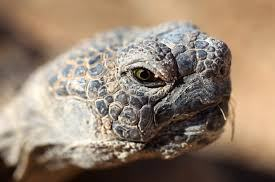
Our Tortoise Managerie

tortoise wikimedia.org images
Wikimedia.org

Our family built a backyard tortoise rescue operation in the 1950s and 60s.

My father worked at Edwards Air Force Base in California, site of the development and testing of the X15 experimental rocket plane, known widely as “the first airplane to reach Mach 3, Mach 4, Mach 5, and Mach 6.” As a small girl, I once watched close up (hands over my ears) as the plane broke the sound barrier.

My father’s drive to work took him from Ontario, on the desert edge of LA, along the San Bernardino freeway east until it veered north through a cleavage in the San Bernardino Mountains, into the desert toward Barstow, before finally swinging west toward Mohave. Long stretches of his drive were on roads dissecting the heart of the California high desert, where the tortoise has lived for over two hundred million years.

Man-made roadways like those he traveled slay thousands of desert tortoises.

Sometimes on his way to work or back my dad passed dozens of crushed tortoises. He once told of his fury at a truck driver he had seen deliberately target a tortoise and smash it.

Sighting the lumbering creature making its slow way across the highway, he had pulled over to the verge, intent on dashing into the road to save it when the way was clear. As he stood, visibly, at the road’s margin, a heavy truck veered into the direction of the tortoise, aimed directly at it, and crushed it under its heavy tonnage. My dad was livid.

Man, a planetary disease, its sickness spread by disregard for fellow planetary inhabitants.

On other occasions, spying a desert tortoise ambling across the highway, my dad would slow his Volkswagen bug to a near stop mid highway, scoop the tortoise up with his hand, and land it in the seat beside him.

It was for the protection of these creatures that we constructed “The Turtle Yard”—our tortoise rescue operation.

When my parents bought our home, they built a six-foot high brick fence enclosing the back yard. To create the turtle yard, my father added a wire fence covered in honeysuckle parallel to and about 20 feet from the yard’s west side wall. The back and west wall of brick, the inner wall of wire and honeysuckle, and a long, wood slat, red front gate enclosed a 20 by 80 foot section of bare dirt, to which my dad added a watering hole.
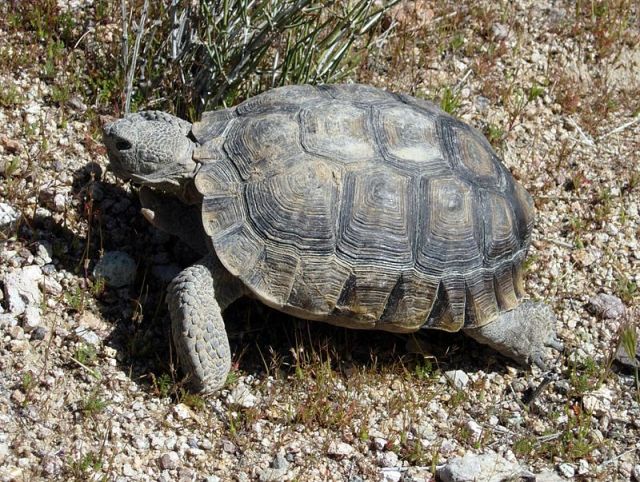
wikimedia.org Wilson44691 DesertTortoise.JPG
Wikimedia.org

This yard housed our growing family of desert tortoises. We quickly collected 20 or 30. Rocky, a huge female, was the champion mama, laying the more eggs than all the others.

One morning, my mom looked out the kitchen window and began yelling. “Ted, Rocky’s loose.” Then, moments later, “Why, it must be Traveler too.” Then louder, and in a more agitated voice, “Ted, come here. The turtles got out! We’ve got turtles all over the back yard!”

They weren’t our tortoises though.

One of my father’s friends had been to a “turtle race.” When no one knew what to do with the assembled tortoises, he offered to transport them to our house and dump them over the back fence. Our tortoise menagerie grew that day from 40 (we were hatching babies) to over 80.dad turtle Scan.jpg
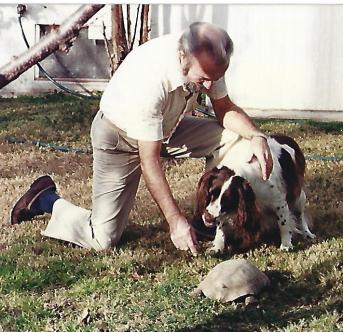
I must have been the only child in my elementary school with a mega tortoise collection. One day, my elementary school principle called me to his office to determine if a large tortoise found wandering on the school grounds was mine. I looked it over. “No, I don’t think so,” I said, “but I’ll take it home anyway.” So that afternoon, I lugged the monster two blocks home to join our tortoise family, where it was welcomed. We did not know, though, that the new tortoise carried a bacteria (either Mycoplasma agassizii or Mycoplasma testudineum), an upper respiratory disease sweeping through the California desert tortoise community.

Soon, a number of our tortoises died from the ravages of this emerging illness.

When this disease struck, we were devastated. Although we had sought to help save the species from human encroachments into their environment, we could not save them from the puzzling illness decimating our tortoise family and so many more of their feral siblings.

This disease was another blow in a list—crushing by automobiles and off-road vehicles, urban development taking over their habitat—that confronted this ancient species. Today, even climate change, causing drought conditions, threatens their survival.

The California desert tortoise has decreased by 90% since the days my father sought to save them in the 1950s and 60s. His way of doing so—scooping them up and bringing them home—is illegal today.

Instead, reserve habitats—one of which became the home of our remaining tortoise family after my father died—are dedicated to their survival. To help save the species, people can even legally “adopt” a tortoise through the California Turtle and Tortoise Club.

During my childhood, our rescue plan seemed like a good strategy, but it was insufficient. Yet like the hardy Bristlecone pine, the California desert tortoise still survives—barely—amidst its alarming losses and reduced habitat. Other species, less supported by preservation efforts, may not persist at all, though, unless more people stop acting like planetary diseases and begin behaving like co-inhabitants of a shared globe.

We need to stand up for this planet. People of all religious, political, cultural, national, and other differences need to take a stand against greed and for the earth.

We have a common stake in this.

I struggle to be effective as an environmentalist. But I know this: more people must work together than are currently doing so if we are to protect this planet, home to over 7.6 billion humans and a host of other incredibly wonderful species.

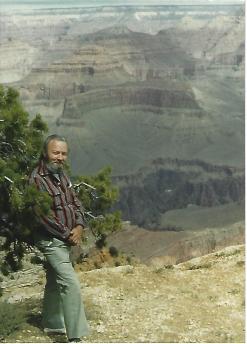
“Man, a Planetary Disease”

DadOur garage—my dad’s domain—was a black widow spider haven with its dingy, dust-filled corners, crammed spaces, and caved in boxes, piled awkwardly one inside another, empty, like promises unfulfilled.
This space was an odd reflection of both my father’s strengths and his disappointments.

His big workbench filled one end of the square garage, while a long chest of drawers heavy with nails, screws, bolts, old metal bits, wires, tools, sandpaper–the odd assemblage of a WWII aeronautic mechanic—filled another: treasured opportunity to my dad, the son of a ranch hand and farmer, an airplane mechanic by profession, and a scientific inventor at heart; and interesting to me, a scruffy child in need of new discoveries.

As messy as it was, my dad’s garage fostered learning. It was there he constructed a rock polishing machine where I discovered that hidden beauty glistened in ordinary chunks of the earth’s crust.

wikimedia.org hatching tortoise download
Wikimedia.org

My dad constructed a vice for me there on a small workbench, and I learned to use a hammer and saw. We built a wooden airplane; I sanded a wood block into a cross; we constructed a go-cart.


It was there he built an incubator where we hatched desert tortoise eggs. (Later, we learned that they did better nestled in a box under our water heater.)

As I wandered through the garage one day, my dad handed me a booklet. “Here, you should read this,” he said in his gruff-hiding-love type voice.

I took the booklet and read the title: “Man, a Planetary Disease.” Wow. Not a comforting title to an emerging young adult. I was still trying to figure out who I was, whether I had anything to offer the world, whether I was likable, how to clear up my pimples. I looked the booklet over, imprinting its title in my brain, but at the time, I did not read it.

I have read it since, though, and I have come to believe that my dad and the booklet’s author, Ian L. McHarg, understood something important.

In the B. Y. Morrison Memorial Lecture in 1971, McHarg argued:

Man is an epidemic, multiplying at a super-exponential rate, destroying the environment upon which he depends, and threatening his own extinction.

He treats the world as a storehouse existing for his delectation; he plunders, rapes, poisons, and kills this living system, the biosphere, in ignorance of its workings and its fundamental value.

The real battle in the world is not between communists and capitalists, black and white, rich and poor, green and purple, heliotrope or gamboge. The real fundamental division in the world is between the people who are not planetary diseases and those who are ….

You may find those words a bit harsh. Obviously, I found it off-putting when I first read McHarg’s title. But McHarg spoke at a time when the world was threatened by nuclear war, DDT, and chemical pollutants inexcusably spewed by irresponsible corporations.

Today’s environmentalists speak amidst other troubles: the threat of nuclear war, biological war, chemical war, everyday war, household pollutants, agricultural pollutants, corporate pollutants, habitat degradation, a killer wildlife trade, plastic islands in our oceans, climate change, and people eager to plunder and rape the world for short-term profit.

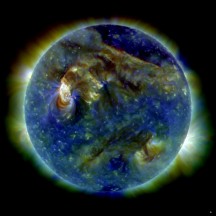
Wikimedia.org August_2010_CME_SDO_Multi-Wavelength.jpgHarsh, yes. But true also. The disease is dangerously out of control. Still, we can fight it. We weren’t meant to be a plague on this beautiful blue and green planet.

My dad was an environmentalist before the word became popular. He passed his love of the earth, seas, land, rocks, and trees on to me. Later, God stamped this concern deep in my soul. People were not made to conquer the earth; we are to care for it as beings who are interdependent with its other creatures and with its complex systems.

We must stop our greedy practices, restore and extend systems designed to let the whole earth flourish, and cherish this beautiful planet. We can do this, but it will take personal and political will if we are to do so.

If we do not, and if we do not see the need to do so as urgent, then we will destroy the planet we call home—we truly will be a planetary disease of epidemic proportions.

Featured

The Pine Trees of My Childhood

The pure scent of pine trees and the terrible stench of smog—these opposites planted the first small seeds of love for the environment in my heart.

I grew up in California east of Los Angeles in the 1950s. At that time, the fading rim of the LA megalopolis encroached like a consuming alien on the hot desert edge where I lived. As Los Angeles grew, it ate into the orange groves that were once ubiquitous in the valleys, and it devoured the surrounding hillsides and deserts.

Finally, it ate into the air, as well.

As the heat rose in late spring and summer in the 1950s, Southern California smog became a problem of London-before-coal-laws proportions. I remember deep aches in my chest after playing outside in the smog. Frequent smog alerts shortened school days at my elementary school and held us children captive, inside.

Old people died from the pollutants in the air.

LA’s smog descended upon our stucco houses, smothering their soft yellows, whites, or pastel blues. The haze depressed me as I grew, with its dullness, its irritants, and its poisons: reminders of dimmed colors, lost orientation, and smog smothered dreams.

Whole mountain ranges disappeared behind smog’s poisonous veil.

In winter Mount Baldy, part of the San Bernardino mountain range located due north of Ontario, my hometown, was the glory of the region. In late spring and summer, though, Mount Baldy vanished for days, even weeks on end. If I was an early riser I might catch a mystic glimpse of it, before smog once again obliterated it from sight.


                                 Wikimedia.org

The camp grounds on Mount Baldy were at a sufficiently high altitude, though, that even in the 1950s, we could camp above the heavy smog. My father and I did this on occasion, rising into fresh mountain air, into the crisp California night, into the stars, where the Milky Way felt like a touchable entity, the stars were bears and seven sisters, and they could be located by a small girl and her father equipped with a star-gazer map.

My favorite memories with my father are of us camping there, snuggled side-by-side in our sleeping bags—tent free, so we could study the stars.

In this private world, pine trees hovered over us like friendly, sheltering giants. As my father and I lay beneath the stars, we talked about astronomy, watched meteoroids flash across our view as they entered the atmosphere, discussed the misery of smog and its destructive effect on the natural world, and talked of how nice it was to camp high in the mountains, until I fell asleep, knowing that I would awake to the familiar scent of my father fixing bacon and eggs, and of the pure mountain scent of pine sap.

The pines where we camped had not yet succumbed to the effects of the smog. This toxin would soon rise from the valleys below, though. Like creeping tendrils of wild vines entangle, bend, and break structures, slowly turning them to ruins, smog would soon rise and poison the trees even at these high elevations, turning them brown and making them die.

All this destruction happened in the 1950s, 60s, and 70s, before humankind regained its sense and acted to stop the devastation.

By the 1960s, the frightening effects of smog on California’s trees, and particularly its pines, were becoming understood. By that time, smog had killed 46,000 acres of pine trees in our San Bernardino forest. Many died—but not all.

By the 1990s, environmental guidelines had begun to heal our sickened air. Some people resented these rules, imposed on home incinerators, industries, and cars. (Most disliked? The catalytic converter.) Despite their outcries, though, the regulations saved our mountain pines, at least for the time being.

I am truly indebted to the scientists, environmentalists, and activists of the mid-20th century who combined their efforts to save human lives and the remaining pines by enacting effective anti-smog regulations.

The smog of my childhood was visible and stank. The grey death stench of climate change is invisible, but it is just as real. Its shadow shows in the bleaching of our coral reefs and in the melting of our polar ice caps.

To make a difference today, we need to cooperate with our international neighbors on climate change strategies. We need to work together to resist efforts to undo climate change policies and regulations.

Although today I still struggle to know how to have an impact as an environmentalist, my concern for the natural world began when I was a child living with the terrible effects of people-made smog, on me and on the pine trees.

I struggle to know what I can do, and one way I’m seeking to grapple with the problems faced by our earth is by writing this blog.

A great deal has already been lost, but not all. We have worked together before and we have been successful. We can still heed the warning of the pine trees of my childhood, and protect this precious planet—if we will.