God’s Immanence in a Rose: Reflections from New Year’s Day

Scotland 12 37217421_10212201409055299_7486753352756232192_nAt the Rose Parade, flowers reign. For those unversed in parade rules–every surface inch on every float—from huge twirling elephants to the image on the elephant’s IPad—must be covered in natural materials–dried stretched seaweeds, tea leaves, cranberry seeds, corn, beans, or rice. Herbs like cumin and cloves. Carnations, mums, daisies, orchids, bird of paradise flowers, and half a million or more roses. No artificial plant materials or coloring are allowed—nature’s colors are dramatic enough.

New Year’s Day, to me, always means the Rose Parade. Watching in 2019, its 130th anniversary, the parade of floats evoke the sublime!

I lived in Pasadena, the Parade’s home, for six crucial years of my life. I attended Pasadena City College for one year (before transferring to Occidental College nearby), worshipped at a Pasadena church, met and married my husband in Pasadena, graduated from Fuller Seminary in Pasadena, and stood on Colorado Boulevard watching the Rose Parade as often as I could.

One year when I was a child, my dad packed my sister and I into our VW bus, drove to Pasadena, parked near the parade route, and staked out a viewing place while my sister and I struggled to sleep in the van. The overnight celebrations on the parade route are lively. We didn’t sleep much. By the time we found our spot and the parade began, I could barely keep my eyes open.

I’ve camped in the van, slept on the sidewalk to get a seat at the curb, stood behind deep rows of crowds to catch parade glimpses, and sat in the bleachers (once).

Many of my pivotal life memories occurred in this city that dedicates its parade to roses—a parade that reminds me how much poorer the world would be without flowers.

To me, God shows up in flowers.

God as transcendent, who exists above Creation, and God as immanent, who can be met through Creation, join harmoniously in the theology that guides my life. As St. Patrick put it:

I arise today, through God’s strength to pilot me,

God’s might to uphold me,

God’s wisdom to guide me….

I arise today, through the strength of heaven,

The light of the sun,

The radiance of the moon….

To the Christian academic and writer C. S. Lewis, beauty—like music or the scent of a rose—serve as a metaphor of our longing for Heaven. In his sermon “The Weight of Glory,” Lewis wrote:

The books or the music in which we thought the beauty was located will betray us if we trust to them; it was not in them, it only came through them, and what came through them was longing…. For they are not the thing itself; they are only the scent of a flower we have not found, the echo of a tune we have not heard, news from a country we have never yet visited.

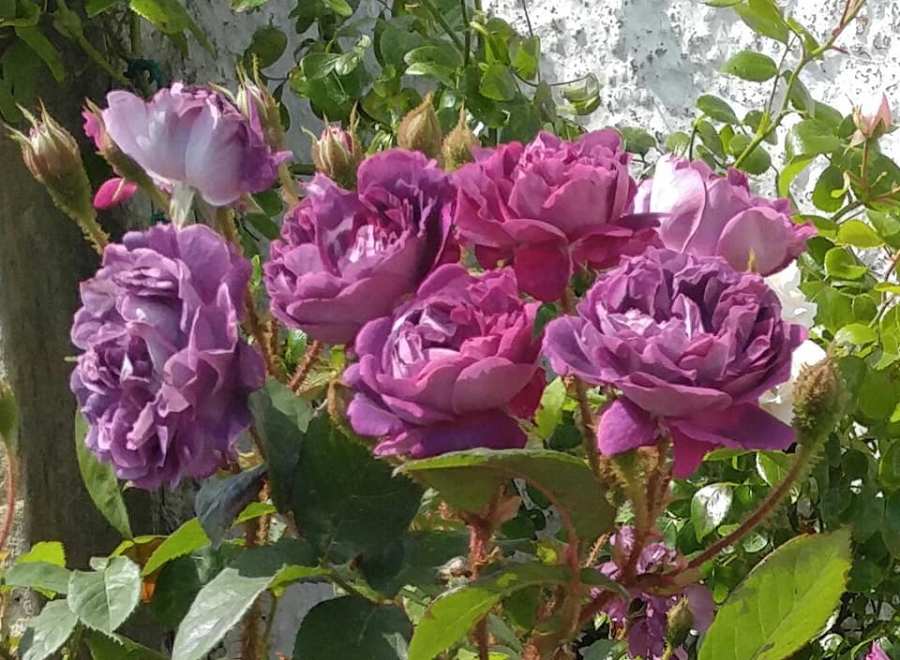
God present in the world He has made. Through it, God hinting at a world we have not yet seen. God present in roses—even at the Tournament of Roses.

One more reason to protect the flora and fauna of this world.

Something Positive I Could Do

I sometimes feel so discouraged by the groaning of this lovely blue and green planet that I succumb to negativity. And then I feel worse.

Rather than just feeling ashamed of my own poor environmental practices, or angry about the abject failure of people in power to take the needs of the planet seriously, I am trying to find small ways to do things that are constructive. Something positive.

GarlicMustard see credit_-_Photo_-_Flickr_-_USDAgov
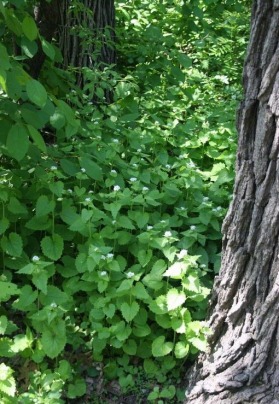
Invasive Garlic Mustard. Photo by Steven Katovich, U.S. Forest Service.

One of those involved participating in a Nature Conservancy Invasive Garlic Mustard Pull in Indiana, where I live now.

I’ve been a member of the Nature Conservancy for maybe 25 years. I love their work, and I like the way local chapters offer hands on opportunities for people to help.

A few years ago, a small group from my church joined our local chapter in its efforts to fight back against invasive garlic mustard at Cedar Bluffs near Brown County, Indiana. The Nature Conservancy now owns the Cedar Bluffs Nature Preserve, “named for the gnarled red cedar trees that cling to its cliffs” according to naturalbloomington.com, and is seeking to protect this fragile ecosystem for future generations.

Invasive plants are one of the reasons fragile environments like this need protection.

The garlic mustard plant, with its dainty white flowers, was once safely boxed in, fenced in, and contained within home herb gardens. But all that changed.

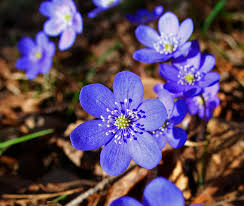
The hills and valleys of Brown County, Indiana, an hour south of my home in Indianapolis, are made of moraines left at the terminus of the glacial advance during the ice age, unlike the northern part of Indiana, which was sliced flat. Native wild flowers like wild ginger, trillium, and hepatica thrive in this undulating area.

hepatica free wikimedia.commonsimages
Hepatica. Wikimedia.commons

Cedar Bluffs sits amidst these moraines.

Wildflowers are so prolific at Cedar Bluffs that botany students from Indiana University visit it regularly for their studies. But this site, like so many other treasures gifted to us by this earth, could soon be lost because it is being engulfed by this simple plant, which has turned invasive.

Some conservationists speculate that as developments edged deer territory, hemming them in, deer wandered through home gardens and carried garlic mustard seeds to woods, fields, hills, and valleys. The plant has an amazing ability to self-fertilize and, unfortunately, few natural enemies in North America.

This dainty flower appears unobtrusive. Once I became familiar with it, though, I saw it everywhere–in my neighbor’s back garden, near the edges of remnant forests, and along the verges of lanes and highways. In Indiana, this little intruder has been devastating. The Nature Conservancy describes it as “one of the ten most destructive invasive species in Indiana today.”

Garlic mustard has an unexpectedly potent destructive ability. Where garlic mustard grows, all other species are crowded out. It’s like a child who, upon entering a room, begins running around knocking things over and causing sudden havoc. But in this case, garlic mustard isn’t just irritating. The havoc it causes is deadly to competing species. Nothing remains but it.

Once at Cedar Bluffs, our group set out on a small trail following a tributary of Clear Creek and then climbing up the limestone cliff with its cedar trees, rock formations, and copious undergrowth. As we walked along the bluffs our Conservancy guide showed us dozens of plants, helping us avoid crushing the native flowers while introducing us to the invader taking over their habitat.

During the garlic pull, our group filled over 20 large black garbage bags with this invasive plant. More mustard remained, but we limited its destructive potential by eliminating it in places and thinning it as best we could.

The Conservancy returns to this site year after year, in a persistent effort to salvage this bounty of native species. While the Nature Conservancy cannot stop all the ravaging done to wildlings by such invasive species, they can preserve a few of our most pristine sites.

Garlic mustard is only one of a numbers of invasive plants taking over across the country. Our action against it was just one small step for nature and biodiversity.

It was, however, something positive that I could do.